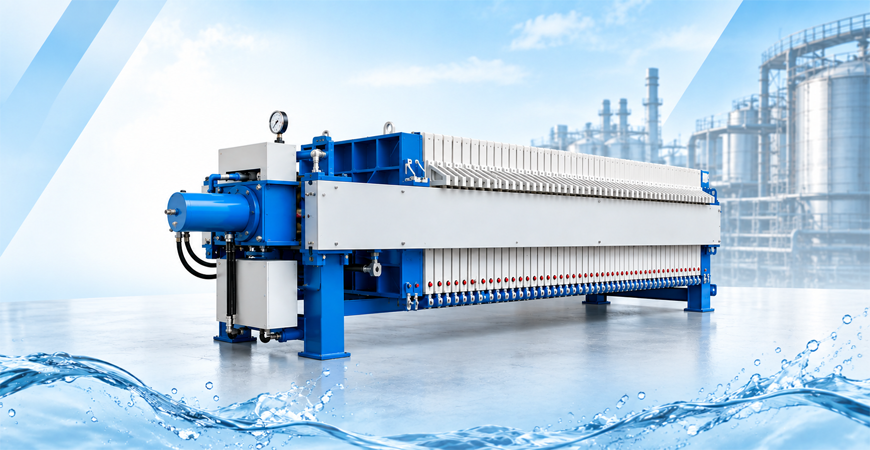
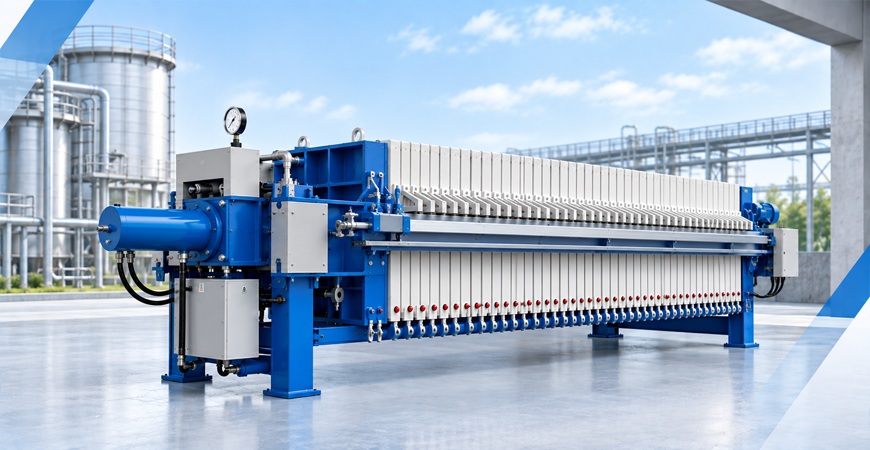
How to Select the Right Filter Press for Your Industrial Application
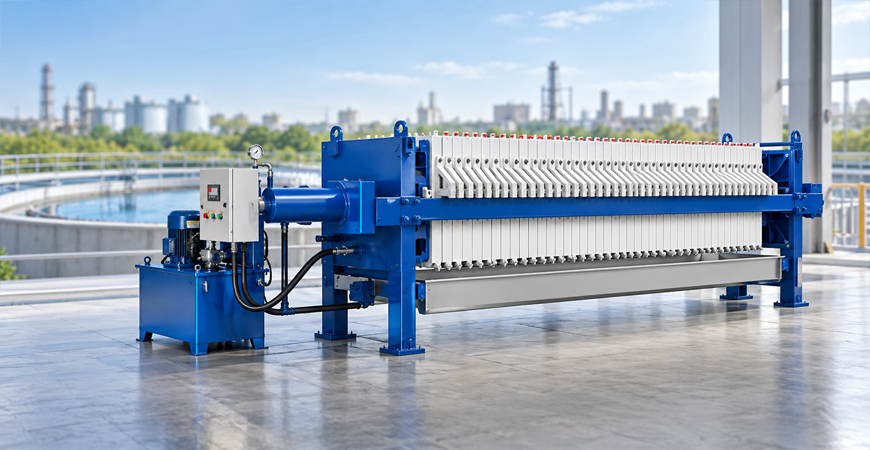
How to Select the Right Filter Press for Your Industrial Application
Choosing the right filter press is essential for achieving efficient solid-liquid separation in industrial processes. The correct machine can help improve filtration performance, reduce sludge volume, recover valuable materials, and support smooth plant operations.
However, different industries have different filtration requirements. Factors such as slurry composition, processing capacity, filter cake moisture, and automation level must be considered before selecting a filter press machine.
In this blog, we will discuss the key factors to help you select the right filter press for your industrial application.
Understand Your Slurry Characteristics
The first step is to understand the material that needs to be filtered. Slurry characteristics directly affect filtration speed, filter cloth selection, and the quality of the final filter cake.
Consider the following properties:
- Particle Size : Fine particles may require a suitable filter cloth and specific filtration conditions.
- Solids Concentration : The amount of solid material in the slurry influences chamber capacity and filtration time.
- Liquid Properties : Viscosity, temperature, and chemical composition affect filtration performance.
- Chemical Compatibility : Filter plates, cloths, seals, and other components must withstand the slurry being processed.
Understanding these factors helps identify a suitable filter press configuration.
Determine the Required Filtration Capacity
Filtration capacity is one of the most important factors when selecting an industrial filter press. You should calculate how much slurry needs to be processed per hour or per batch.
The required capacity depends on production volume, solids concentration, filtration cycle time, and the available operating hours.
A filter press with insufficient capacity may create production delays, while an unnecessarily large machine may increase initial investment and operating costs.
Choose a system that matches your actual production requirements and expected future demand.
Consider the Required Filter Cake Moisture
A filter press separates liquid from solids, forming a filter cake inside the filtration chambers. The required moisture content of this cake is an important selection criterion.
If your process requires drier solids, consider whether a membrane filter press or another suitable configuration can meet your requirements.
The achievable cake moisture depends on the slurry, particle characteristics, operating pressure, filter cloth, and machine design. Filtration testing can help determine the most appropriate solution.
Select the Right Type of Filter Press
Different filter press types are designed for different operating conditions and filtration needs.
- Plate and Frame Filter Press : Suitable for various batch filtration and solids recovery applications.
- Recessed Plate Filter Press : Commonly used for industrial filtration and sludge dewatering.
- Membrane Filter Press : Suitable for applications where additional cake compression and lower moisture are important.
- Fully Automatic Filter Press : Useful where automated plate shifting, cake discharge, and cycle controls can improve operational efficiency.
The best option depends on your process requirements, production volume, maintenance capabilities, and budget.
Evaluate Automation Requirements
The level of automation can affect productivity, labor requirements, and operating convenience.
A manual filter press may suit smaller operations with limited filtration requirements. Semi-automatic and fully automatic systems can reduce repetitive manual tasks and help maintain consistent operating cycles.
Before choosing an automatic filter press, check which functions are automated, such as plate movement, cake discharge, and cycle control.
Check Maintenance and Operating Costs
The purchase price is only one part of the total cost of owning a filter press. Regular maintenance and consumable replacement also affect long-term operating expenses.
Evaluate filter cloth life, cleaning requirements, spare parts availability, energy consumption, hydraulic system maintenance, and service support.
Selecting a machine that is easy to maintain can help reduce downtime and support reliable performance.
Consider Installation Space and Safety
Before finalizing your equipment, review the available installation area and plant layout. Ensure there is sufficient space for the filter press, feed pump, piping, filtrate collection, and filter cake discharge.
Also check operator access, safety interlocks, maintenance clearances, and the handling arrangements required for the discharged solids.
Common Industrial Applications
Filter presses are used in several industries for solid-liquid separation, including:
- Wastewater Treatment : Dewatering industrial sludge.
- Chemical Processing : Separating solids from chemical mixtures.
- Mining : Dewatering suitable mineral concentrates and tailings.
- Textile Industry : Processing sludge from wastewater treatment.
- Ceramic Industry : Removing water from ceramic slurries.
- Manufacturing : Recovering solids and separating process liquids.
Each application requires a suitable combination of filtration capacity, filter media, and operating conditions.
Frequently Asked Questions (FAQs)
Slurry characteristics are a key starting point. Particle size, solids concentration, liquid properties, required capacity, and desired cake moisture all influence equipment selection.
Recessed plate and automatic filter presses are commonly considered for wastewater sludge dewatering. The appropriate choice depends on sludge characteristics and plant requirements.
An automatic model can reduce manual intervention and simplify repetitive operations. However, the best option depends on production volume, labor availability, budget, and required automation.
A properly selected filter press may reduce sludge handling costs and support water recovery. Actual savings depend on the application, energy use, maintenance, and disposal requirements.
Conclusion
Selecting the right filter press for your industrial application requires careful evaluation of slurry characteristics, filtration capacity, filter cake moisture, machine type, automation, and maintenance requirements.
A suitable filtration system can improve solid-liquid separation, support efficient sludge management, and contribute to reliable industrial operations.
Maruti Filtration Systems Pvt. Ltd. provides filtration equipment solutions for industrial requirements. Contact the team to discuss your application and identify a suitable filter press configuration for your facility.